Showing posts with label Lacan. Show all posts

We Love Vampires!

I belong to a generation that can only be defined by its lack of definable characteristics.  We are Generation Why?: the generation of facebook, texting and general apathy.  Current events are hardly a blip on the perpetual computer screen, but there is a bloody war raging between teams Edward and Jacob.  So what is it about vamps that has caused such a stir in pop culture in the past few years?


Here is where I introduce this crazy theory I'm working on that I like to call The Vampiric Reverse Mirror Stage. This is the idea that if we, as humans, all go through the mirror stage then there must be a similar process for vampires.  I propose that the first time a Vampire looks in the mirror after the transformation, the opposite effect occurs.

According to Lacan, "We have only to understand the mirror stage as an identification, in the full sense that analysis gives to the term: namely, the transformation that takes place in the subject when he assumes an image."  So the VR Mirror Stage, is a fragmenting process rather than the identification that Lacan is talking about here.  In this case the subject loses its image, rather than assuming one.  They are, essentially the others in the world now, and no longer have an other to look at in the mirror.  They are a set of limbs flailing about reaching for some semblance of wholeness.  They are no longer human and this symbolizes the absolute absence of humanity.

So you might be thinking, "What the heck does this have to do with apathetic youth?" and my answer once again refers back to the concept of identification, but this time we're back to the "real" world.  We, as a group, have no identity as shown by the previously discussed lack of defining characteristics.  So I think that it becomes easy to identify with these non-existent creatures who have always been somewhat illusive in their lore.

Hence the creation of the misunderstood vampire in the last decade or so.  Vampires with souls and the capability to love (yada yada yada.)  Young people can relate to these ideas of monsters who are just searching for their identity in the big bad world, because that's how they like to see themselves.  They look through the screen and see themselves as the enchanting characters who are simply trying to figure out who the hell they are.

Plus, Vampires are the teenagers of all monsters: They are always hungry, they answer to no one, they go through friends like toilet paper, and they sleep all day.  Anyone would feel connected, really.

More textual evidence about my fun little theory to be developed.  Stay tuned!

Vampires. Mirrors. Lacan.

"It amazed me that I had not seen him, since the reflection of the glass covered the whole room behind me... I turned to the glass again to see how I had been mistaken. This time there could be no error, for the man was close to me, and I could see him over my shoulder. But there was no reflection of him in the mirror!" (Stoker 26).

I can imagine that the connection between Lacan and vampires' inability to see themselves in the mirror have been linked to the nth degree, but I suggest that this class doesn't assign The Mirror Stage if you guys are sick of hearing about it.  As it stands, I am going to go ahead and take a look at this unmistakable connection.  There are several ways to interpret this scene in Bram Stoker's Dracula, all of which I can't really cover in this one post, so I am going to focus on Jonathan Harker's reaction to the missing "man" in the mirror.

Harker, being a grown man, has long ago experienced "The Mirror Stage," in which he gained recognition of his image and, therefore, his identity.  In this class we have discussed this experience as a moment of self-othering, in the discovery of one's self as an object.  This is why I propose that when Harker notices Dracula's lack of reflection, he is once again appearing to himself as other, as though going through this process all over again. 

Despite the fact that Dracula is clearly in the room, he can only see himself in the mirror.  So how can he differentiate himself from this vampire who stands before him?   He looks back at Dracula and this is the moment where he is face to face with his Gothic other.  The other that no longer exists in the mirror, but has found his way into the real world.  This, "increase[s] the vague feeling of uneasiness that [he] always [has] whenever the Count is near" (Stoker 26). 

This minor description of what has just been unleashed within the text is not lost on me.  I think that this further proves my point in that, like a child, Harker has no clue what he has just discovered.  He is only confused at the realization that he is facing a man, who he can see is whole, and yet there is no image in the mirror.  Harker has yet to realize that he is, in fact, the equivalent of a mirror image to Dracula.

So the idea is that when I look at my Gothic other in the mirror every morning, my other is looking back at me.  Harker can see himself in the mirror, because his other is right there beside him, being reflected.

Can't Find an Other? Make Your Own!

It worked for Frankenstein didn't it?  Well...worked is relative here, but he certainly did it!

We are introduced to Victor through his letters at the beginning of the novel, in which he tells the reader of his childhood and his family life.  It is clear that he has love for his mother, who dies just as he is going away to school, however he does not entirely connect with her on any intellectual level.

He then goes on to talk about his introduction to science and his growing infatuation for the subject.  This is where we first see the emergence of M. Waldman as "a true friend."  Seeing as how Victor quickly surpasses the masters, it can be said that he is not looking for an equal, but someone who will "express the most heartfelt exultation in [his] progress" (Ch.4)  He does not necessarily need him to understand the work that he is actually doing so much as how excellent and important his findings are.

Frankenstein's description of, "one of the phenomena which had peculiarly attracted [his] attention was the structure of the human frame, and, indeed, any animal endued with life," is particularly foreshadowing of the events to come.  In the same passage he talks about how the "fine form of man was degraded and wasted," which is another moment that implies how he might feel about the monster he has yet to create (Ch.4).

Frankenstein's reaction to he man he makes later on in the book shows how he is very much Waldman's opposite.  He takes no pleasure in the development of the creature, nor does he make any attempt to understand it.  He simply flees at the sight of "the wretch -- the miserable monster whom [he] had created.".  This is an interesting outcome considering the project was aimed at manipulating the human body, which he found so fascinating and beautiful.


He looks into, "his eyes, if eyes they may be called," and this moment he faces his other, which he never intended, or wants, to see (Ch. 5).  This is a pseudo Mirror Stage moment in Shelley's novel that gives the reader their first glimpse into Frankenstein's true nature.  Here we have an unreliable account of our protagonist, because he has been the one telling his own story.  The ugliness that is seen in the monster acts as a physical manifestation of what he has been holding within himself.

The action of running away from the monster serves as a representation of Frankenstein's repression of his own id.  The monster within him has now been unleashed into the world and even after being forced to face the creature, Frankenstein still wishes to pretend as though it does not exist.  As Professor Moglen likes to remind us: the greater the repression, the greater the eventual explosion is bound to be.  Thus is the case as the monster continues to roam about the world, and eventually seeks its revenge on Frankenstein.

In his vengeance, the monster kills several of Victor's loved ones, but what serves as a concrete action of "otherness" is the murder of his father.  Victor, who for all intents and purposes is the monster's father, was never active or present after it was "born."  The monster takes from Frankenstein exactly what was deprived of him.  Now, they are both orphaned.

Frankenstein continues to repress the monster that he has let out into the world and the matching id still within him rages on as he keeps the secret of his science project to himself.  In the end, he reveals this secret and it is not he who works out his own unconscious, but rather it is left to Walton to unravel the story of Frankenstein's id: his monster.

Fearing Fragmentation

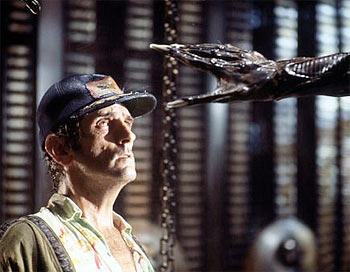
Today in section we discussed the monster in the film, Alien (1979), and how hiding the monster effected our viewing experience.  It is apparent to me that the entire industry of horror (and its sub-genres such as science fiction) was built largely on the inducement of suspense.  If a movie refrains from showing what we are meant to be afraid of for its entirety, waiting until the very end to reveal it, this can create greater fear for the audience.

That being said, I don't think such was the case in Alien.  We were never given the opportunity to really see the monster in full until it is hanging from the shuttle at the very end of the film.  The "big reveal" is fairly anti-climactic in my opinion.  In this particular film, I think it can be said that we are meant to fear what is unknown.  As the monster continues to grow and change, adapting to its new environment, we are never given a clear image of our other.


The alien is presented to us in bits and pieces as it travels about the ship in search of its next meal.  The film takes us, shot by shot, throughout the ship, making it seem as though we too are in danger of being eaten at every turn.  But we are only told, never shown, how frightening the monster truly is, as the camera closes up on the terrified face of whoever is encountering the beast.

So if the glimpses we receive do not successfully effect suspense, why do we watch the film?  How does it scare us?

My answer to this question is that it is the lack of wholeness itself that induces fright.  We watch and flail about seeking some sense of unity in our other.  We want something to look at in order to gain an understanding of that which we fear, but we are never allowed this by the film.  As the creature develops it never "extends from a fragmented body-image to a form of its totality," as the human does according to Jacques Lacan's Mirror Stage.  Thus we are left to stare at the images mirroring our own world, destined to forever lack a sense of self-identification for we cannot see the monster is the same, nor how it differs from us.  Our fear then lies in being trapped in a primitive state of fragmentation.