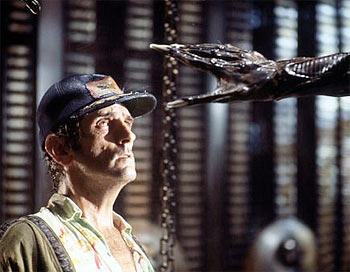
You might have thought I'd exhausted the subject of Alien (1979), but you were wrong. I have so much more to say! Get excited.
I would like to go into part of one of the prompts for the first essay: "While Frankenstein and Alien both attempt to deconstruct gender difference, both texts ultimately reinstate the male/female opposition and give precedence to the values of the feminine. Discuss, with reference to the film and the fiction." I think that there are some really interesting parallels between these two texts, but I really just want to cover the circular formation of Alien (1979), and how it serves to both deconstruct and then reinstate the gender roles of its characters.
The conflict is created when Kane, the ship's (male) second-in-command, disturbs an egg on a foreign planet. The alien attaches itself to his face and he becomes the surrogate for this life form until it rips through his stomach in a twisted version of childbirth.
It is in this reversal the biological roles of man that confirms the deconstruction of gender roles previously hinted at within the film.
Ripley has the more traditionally masculine characteristics of logic and levelheadedness, while Dallas is more inclined to take risks based on his emotions. He is the one who insists that Kane is let back into the ship, despite the danger this presents to the rest of the crew members. He violates protocol once again by trying to cut the alien off of his friend's face in an attempt to save his life.
As they are terrorized by the monster on their ship, Ripley remains cool and collected, fulfilling the kick ass quota necessary to all films of this genre, although generally played by a man. It is not until she is the last one standing that we are reintroduced to her womanhood. She strips down to her undies, in what we might consider a predictable fashion for a horror film, however it is so random here because of how unfeminine our protagonist has been throughout.
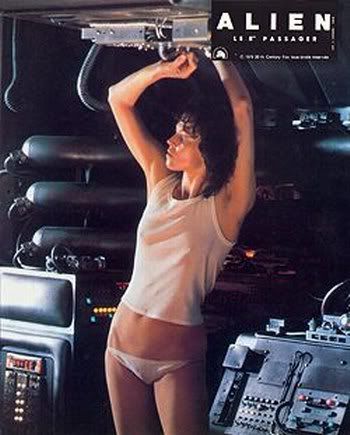
This reminder of feminine sexuality serves to prepare us for a return to social constructs. We are completely thrown out of the norm, forced to accept a man giving birth and a woman succeeding in the Darwinian game of survival of the fittest. Now we must return to reality.
In order to reinstate "the male/female opposition and give precedence to the values of the feminine," the alien must be reborn in a way that can be considered normal. Then, naturally, it must be destroyed. We are given this imagery when Ripley propels the alien from the pod, not unlike the way it originally hatched at the beginning of the film. The alien hangs from the ship from a pseudo umbilical cord which is eventually cut by explosive flames from the engine.
The alien's rebirth is initiated by a woman and it comes from what is identified as the feminine "mother" ship. This is a final representation of a return to the accepted gender roles. Ripley is re-feminized, and the alien is at last born of a woman. Everything is "right" in the world.
So, since: a) no one reads this blog, and b) I am not currently writing anything outside of my classes, I have decided to do something of an archaeological dig into my "creative past." I am searching my archive for all things written and I will post it. It will be embarrassing and it will be true.
Showing posts with label Alien. Show all posts
Fearing Fragmentation
Today in section we discussed the monster in the film, Alien (1979), and how hiding the monster effected our viewing experience. It is apparent to me that the entire industry of horror (and its sub-genres such as science fiction) was built largely on the inducement of suspense. If a movie refrains from showing what we are meant to be afraid of for its entirety, waiting until the very end to reveal it, this can create greater fear for the audience.
That being said, I don't think such was the case in Alien. We were never given the opportunity to really see the monster in full until it is hanging from the shuttle at the very end of the film. The "big reveal" is fairly anti-climactic in my opinion. In this particular film, I think it can be said that we are meant to fear what is unknown. As the monster continues to grow and change, adapting to its new environment, we are never given a clear image of our other.
The alien is presented to us in bits and pieces as it travels about the ship in search of its next meal. The film takes us, shot by shot, throughout the ship, making it seem as though we too are in danger of being eaten at every turn. But we are only told, never shown, how frightening the monster truly is, as the camera closes up on the terrified face of whoever is encountering the beast.
So if the glimpses we receive do not successfully effect suspense, why do we watch the film? How does it scare us?
My answer to this question is that it is the lack of wholeness itself that induces fright. We watch and flail about seeking some sense of unity in our other. We want something to look at in order to gain an understanding of that which we fear, but we are never allowed this by the film. As the creature develops it never "extends from a fragmented body-image to a form of its totality," as the human does according to Jacques Lacan's Mirror Stage. Thus we are left to stare at the images mirroring our own world, destined to forever lack a sense of self-identification for we cannot see the monster is the same, nor how it differs from us. Our fear then lies in being trapped in a primitive state of fragmentation.
That being said, I don't think such was the case in Alien. We were never given the opportunity to really see the monster in full until it is hanging from the shuttle at the very end of the film. The "big reveal" is fairly anti-climactic in my opinion. In this particular film, I think it can be said that we are meant to fear what is unknown. As the monster continues to grow and change, adapting to its new environment, we are never given a clear image of our other.
The alien is presented to us in bits and pieces as it travels about the ship in search of its next meal. The film takes us, shot by shot, throughout the ship, making it seem as though we too are in danger of being eaten at every turn. But we are only told, never shown, how frightening the monster truly is, as the camera closes up on the terrified face of whoever is encountering the beast.
So if the glimpses we receive do not successfully effect suspense, why do we watch the film? How does it scare us?
My answer to this question is that it is the lack of wholeness itself that induces fright. We watch and flail about seeking some sense of unity in our other. We want something to look at in order to gain an understanding of that which we fear, but we are never allowed this by the film. As the creature develops it never "extends from a fragmented body-image to a form of its totality," as the human does according to Jacques Lacan's Mirror Stage. Thus we are left to stare at the images mirroring our own world, destined to forever lack a sense of self-identification for we cannot see the monster is the same, nor how it differs from us. Our fear then lies in being trapped in a primitive state of fragmentation.
Subscribe to:
Posts (Atom)