I have so much to say in response to Robert Stevenson's, Strange Case of Dr. Jekyll and Mr. Hyde, and I am most certainly not finished with The Yellow Wallpaper, but I'd just like to first respond to a question posed in class.
First though, I want to reinstate the classifications that Professor Moglen gave for Freud's concepts of the love towards parents:
Identifacatory Love- Parent with whom the child identifies and wants to be like.
Object Love- Parent that one can imagine loving in the future.
Someone asked what would happen in the case of an abnormal family atmosphere, such as a single parent or a homosexual parents. Professor Moglen responded that this question is often asked of Freud's theory and remains unanswered.
To a certain degree, I can see Stevenson's novel as a bit of a response to this question. There are hardly any women in the novel and Jekyll lost his mother during his own birth. His father at this point is a single parent, left to fill two roles. As a result Jekyll is likely to love his father as an object as well as identify with him.
Stevenson may be making a commentary on this dual relationship through the homosexual tendencies within the novella, particularly in the case of Jekyll's club of gentlemen located on "queer street." The secrets that they keep for one another suggests an unspoken understanding of this sort of behavior. The lack of women and families in their community questions the ability to find someone to fill the role of object love who is not a man. They definitely don't seem to be looking to find women and family on top of that.
So this is what I propose: Dr. Jekyll feels as though he should repress these implied desires because he is Gentleman, as his father was. As a result Hyde escapes from within him and lives out all of Jekyll's dirtiest desires without shame or remorse. One reading we could make is that he didn't even have a mother to identify with in an effeminate manner, thus making him feel alright about his desires. No, he was left to take on the role of the man that his father was, as well as see men as objects of love. But because of the former, he cannot accept the latter!
Really, that would drive anyone crazy. It's no wonder he developed multiple personality disorder and caused his own downfall. It's a lot to handle.
Showing posts with label Fragmentation. Show all posts
Showing posts with label Fragmentation. Show all posts

Fearing Fragmentation
Today in section we discussed the monster in the film, Alien (1979), and how hiding the monster effected our viewing experience. It is apparent to me that the entire industry of horror (and its sub-genres such as science fiction) was built largely on the inducement of suspense. If a movie refrains from showing what we are meant to be afraid of for its entirety, waiting until the very end to reveal it, this can create greater fear for the audience.
That being said, I don't think such was the case in Alien. We were never given the opportunity to really see the monster in full until it is hanging from the shuttle at the very end of the film. The "big reveal" is fairly anti-climactic in my opinion. In this particular film, I think it can be said that we are meant to fear what is unknown. As the monster continues to grow and change, adapting to its new environment, we are never given a clear image of our other.

The alien is presented to us in bits and pieces as it travels about the ship in search of its next meal. The film takes us, shot by shot, throughout the ship, making it seem as though we too are in danger of being eaten at every turn. But we are only told, never shown, how frightening the monster truly is, as the camera closes up on the terrified face of whoever is encountering the beast.
So if the glimpses we receive do not successfully effect suspense, why do we watch the film? How does it scare us?
My answer to this question is that it is the lack of wholeness itself that induces fright. We watch and flail about seeking some sense of unity in our other. We want something to look at in order to gain an understanding of that which we fear, but we are never allowed this by the film. As the creature develops it never "extends from a fragmented body-image to a form of its totality," as the human does according to Jacques Lacan's Mirror Stage. Thus we are left to stare at the images mirroring our own world, destined to forever lack a sense of self-identification for we cannot see the monster is the same, nor how it differs from us. Our fear then lies in being trapped in a primitive state of fragmentation.
That being said, I don't think such was the case in Alien. We were never given the opportunity to really see the monster in full until it is hanging from the shuttle at the very end of the film. The "big reveal" is fairly anti-climactic in my opinion. In this particular film, I think it can be said that we are meant to fear what is unknown. As the monster continues to grow and change, adapting to its new environment, we are never given a clear image of our other.
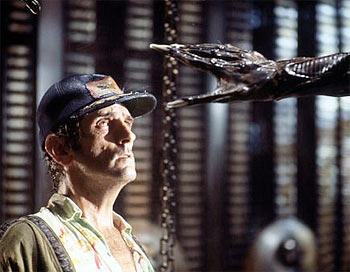
The alien is presented to us in bits and pieces as it travels about the ship in search of its next meal. The film takes us, shot by shot, throughout the ship, making it seem as though we too are in danger of being eaten at every turn. But we are only told, never shown, how frightening the monster truly is, as the camera closes up on the terrified face of whoever is encountering the beast.
So if the glimpses we receive do not successfully effect suspense, why do we watch the film? How does it scare us?
My answer to this question is that it is the lack of wholeness itself that induces fright. We watch and flail about seeking some sense of unity in our other. We want something to look at in order to gain an understanding of that which we fear, but we are never allowed this by the film. As the creature develops it never "extends from a fragmented body-image to a form of its totality," as the human does according to Jacques Lacan's Mirror Stage. Thus we are left to stare at the images mirroring our own world, destined to forever lack a sense of self-identification for we cannot see the monster is the same, nor how it differs from us. Our fear then lies in being trapped in a primitive state of fragmentation.
Subscribe to:
Posts (Atom)